
Table of Contents
ToggleLiving tiny doesn’t mean living without power, it means powering your space on your own terms. Solar panels for tiny houses have become a practical, increasingly affordable pathway to energy independence. Whether you’re considering a minimal mortgage, embracing off-grid living, or just reducing your utility bills, solar makes economic sense at smaller scales where panel arrays fit neatly onto roofs or ground mounts. This guide walks you through the essentials: what type of panels work best in tight spaces, how to calculate your actual power needs, installation realities, battery backup options, and the financial picture that makes solar a smart bet in 2026.
Key Takeaways
- Solar panels for tiny houses offer a practical path to energy independence, with modest 4–6 kW systems fitting comfortably on a 300-square-foot roof or trailer while costing $8,000–$14,000 installed.
- Monocrystalline panels are the smart choice for tiny homes where roof space is limited, delivering 18–22% efficiency and requiring fewer panels than polycrystalline alternatives.
- Calculate your actual energy needs by reviewing 12 months of utility bills, then divide annual consumption by your region’s peak sun hours to right-size your solar system and avoid over-investing.
- Hire a licensed installer to handle permits, electrical codes, and safety compliance—DIY installation risks equipment damage, warranty voidation, and fire hazards that professional work eliminates.
- Grid-tied solar systems require no battery investment and offer monthly bill savings within 6–10 years, while off-grid setups with lithium-ion batteries provide full independence at a higher upfront cost of $23,000–$39,000 total.
- The 30% federal Investment Tax Credit combined with state rebates can significantly reduce your out-of-pocket costs, making solar a compelling long-term investment for tiny house owners planning to stay 10+ years.
Why Solar Power Makes Sense for Tiny House Living
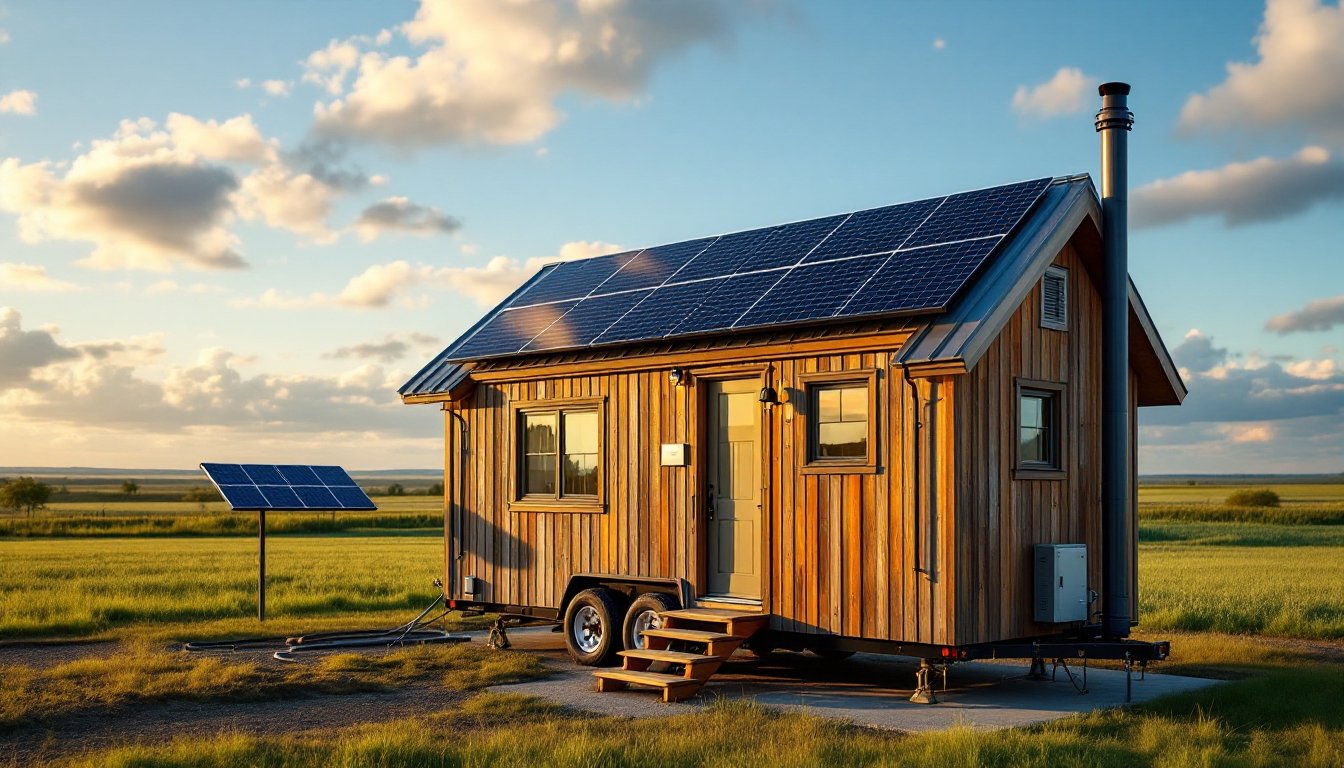
Tiny houses shine (literally) as solar candidates. A typical tiny home uses 4,000 to 8,000 kWh annually, roughly one-third the consumption of a conventional 2,000-square-foot house. That smaller footprint means you don’t need a sprawling 8–10 kilowatt system: a modest 4–6 kW array can often meet your needs, which fits comfortably on a 300-square-foot roof or trailer.
Offering both financial and practical advantages, solar works especially well when a tiny home is financed without a massive mortgage hanging over your head. Many tiny house owners are already thinking about sustainability and cost-cutting: adding solar completes the picture. If your tiny is on wheels, ground-mounted solar on your property (or a separate carport array) gives you flexibility. For site-built tiny homes, roof mounting is standard. Plus, modern solar has become resilient: panels last 25–30 years, inverters are increasingly smart, and financing options have improved considerably.
One honest note: if you’re renting or your roof faces north in a heavily shaded area, solar may not pencil out. But if you own the land and get decent sunlight, the math typically works.
Understanding Solar Panel Types and What Works Best for Small Spaces
Not all solar panels are created equal, and in tight spaces, efficiency matters. Two main types dominate the residential market: monocrystalline (mono) and polycrystalline (poly). A third option, thin-film panels, exists but is rarely recommended for tiny houses because it requires more physical area for the same output.
Monocrystalline vs. Polycrystalline Panels
Monocrystalline panels are cut from a single silicon crystal, making them highly efficient, typically 18–22% efficiency (meaning 18–22% of sunlight gets converted to usable electricity). They’re black, sleek-looking, and perform better in low-light and shaded conditions. For a tiny house roof where space is premium, mono is usually the smart pick: you get more watts per square foot, so you need fewer panels to hit your target output.
Polycrystalline panels are made from multiple silicon fragments, fused together. They’re slightly less efficient (15–17%) but historically cheaper. They’re often blue and perform adequately in full sun. If your tiny’s roof or ground space is generous and budget is tight, poly can work, you’ll just need more panels occupying more real estate.
For most tiny homes, monocrystalline panels are the go-to choice. The space savings and better performance in variable light justify the modest cost premium. Modern residential solar technology has brought mono prices down sharply, narrowing the gap with poly.
Panels typically come in 300W, 400W, or 450W ratings. For a 4 kW system, you’d install roughly 9–13 panels depending on wattage. Check that your roof or ground space can accommodate that footprint, each panel is roughly 65 by 39 inches.
Calculating Your Tiny House Energy Needs and System Size
Before you buy a single panel, figure out what you actually use. Grab your last 12 months of utility bills and note your average monthly consumption in kWh. If you’re not connected to the grid yet, estimate conservatively. A tiny house without electric heating or air conditioning, relying on mini-splits, propane heating, or passive cooling, typically runs 300–700 kWh per month. Add an electric range or resistance heat, and you’re closer to 800–1,200 kWh monthly.
Multiply your monthly usage by 12, then divide by 365 days, then divide by your average peak sun hours (typically 4–5 for most of the continental U.S.: check NREL’s solar resource maps for your exact location). That gives you your required system size in kilowatts.
Example: A tiny house using 500 kWh/month = 6,000 kWh/year. In a region with 4.5 peak sun hours daily, you’d need roughly 6,000 ÷ (4.5 × 365) = 3.6 kW of panels. Round up slightly to account for age-related panel degradation and winter performance dips, so aim for 4–5 kW.
Don’t forget to factor seasonal variation. Winter output is typically 30–40% lower than summer. If you want year-round independence without battery sizing up dramatically, some tiny house dwellers grid-tie with net metering in winter or keep a propane backup.
Be honest about loads, too. High-draw appliances like electric water heaters, large air compressors, or constant air conditioning will demand a much larger system. Efficiency upgrades (LED lighting, a gas or propane water heater, tight insulation) make your solar investment go further.
Installation Considerations for Tiny Homes
Installation complexity varies sharply based on your setup. Roof-mounted systems on a fixed tiny home involve standard racking and electrical runs, hire a licensed solar installer if you’re not a licensed electrician yourself. Most jurisdictions require electrical permits and inspections, especially for grid-tied systems. This isn’t a DIY shortcut: mistakes can damage equipment, void warranties, or create fire hazards.
If your tiny is on a trailer, you have options. Roof-mounted racking adds wind resistance and weight: make sure your trailer frame and hitch rating support it (a 5 kW array weighs roughly 5,000–6,000 pounds). Many trailer tiny homes use ground-mounted arrays nearby instead, which is simpler mechanically but requires land and longer wire runs (minimize voltage drop on wires over 50 feet).
Roof orientation and pitch matter. South-facing (in the Northern Hemisphere) is ideal: east or west facing reduces output by 10–20%. Shade from trees, chimneys, or neighboring structures kills efficiency: even partial shading on one panel cascades losses across the array thanks to how panels are wired in series. Trim branches or skip solar if shade is unavoidable.
Wiring, conduit, and breakers must meet the National Electrical Code (NEC). An external combiner box, a weatherproof main disconnect, grounding, and proper-gauge wire aren’t optional. Undersized wire causes voltage drop and overheating. A professional installer knows these codes and carries liability insurance, worth paying for on a system that’ll run 25 years.
Permitting timelines vary by municipality, but budget 2–8 weeks from application to inspection approval. Some jurisdictions fast-track renewable energy systems: others don’t. Check early with your local building department.
Battery Storage and Backup Power Solutions
Here’s the real trade-off: solar panels only work when the sun’s up. Grid-tied systems feed excess daytime power to the utility and draw at night or on cloudy days, no battery needed, and utilities often credit you for surplus (net metering). But if you want true off-grid independence or live somewhere net metering isn’t available, battery storage is non-negotiable.
Lithium-ion batteries (LiFePO₄ chemistry) are the modern standard for tiny houses. A 10–15 kWh battery bank (like multiple Tesla Powerwalls or LG Chem units, or modular systems like Generac PWRcell) costs $15,000–$25,000 installed but handles most off-grid needs with seasonal grid or generator backup. Lithium is compact, efficient, and lasts 10–15 years. Lead-acid batteries (older, cheaper) require more space, have lower depth-of-discharge limits, and need more frequent maintenance, not ideal for tiny spaces.
Size your battery to your needs, not your budget. If you want full off-grid independence every day of the year, battery size must handle winter multi-day cloudy periods, which gets expensive and space-intensive. Many tiny house owners instead opt for a hybrid: solar + battery for daily use, with a propane generator or grid connection for backup. This balances cost, space, and reliability.
Battery systems require a charge controller (MPPT types are more efficient than PWM) and a hybrid or off-grid inverter that converts DC battery power to AC for your home. Installation is even more complex than panels alone, expect to hire a specialized installer. Safety is critical: DC wiring, fuses, and disconnects must be properly rated and accessible.
Cost, Incentives, and Long-Term Savings
A 4–5 kW grid-tied solar system for a tiny house typically costs $8,000–$14,000 installed (roughly $2–$3 per watt after labor). Off-grid with battery adds $15,000–$25,000 to that total. These are ballpark figures: your region, roof complexity, and panel choice all matter.
Federal tax credits help significantly. The Investment Tax Credit (ITC) covers 30% of system cost (as of 2026: this may shift with policy changes). Many states add rebates, and some utilities offer incentives. Run the numbers through the Database of State Incentives for Renewables & Efficiency (DSIRE) or your installer’s financial modeling to see what applies where you are.
Payback timelines range from 6–10 years in sunny regions with decent electricity rates, extending to 12–15 years in cloudier areas or places with cheap grid power. After payback, 15+ years of near-free electricity remain, that’s real savings.
Honest reality check: if you finance the system through a loan, monthly payments may exceed current electricity costs initially. But rent electricity, and prices climb. Own solar, and costs stabilize. For someone planning to stay in their tiny home 10+ years, it’s hard to beat.
A design precedent worth examining is the solar-powered Orchid tiny house, which demonstrates how integration of solar and thoughtful design maximizes both energy efficiency and livable space, proving that tiny homes can be both power-independent and beautifully functional.